Most people think stress and anxiety shows up and causes racing thoughts, tension or overwhelm.
But what if one of the biggest contributors to stress and anxiety symptoms is the one thing everyone is doing every day.
Breathing.
But more often, over breathing.
This is where your day to day breathing becomes very important.
Hyperventilation (over breathing) is a dysfunctional breathing pattern when you breathe faster than your body needs, causing an imbalance in the levels of oxygen and carbon dioxide in your body. This then directly affects your nervous system, muscles, blood flow and emotional state.
It’s not about getting more air.
It’s about efficiently delivering air to the body.
Symptoms of Over‑Breathing (And Why They’re Not Just Anxiety)
These are symptoms people often blame on anxiety or stress when in reality, they’re classic signs of dysfunctional breathing pattern:
- feeling tense
- blurred vision
- dizzy spells
- feeling confused or spaced out
- faster or deeper breathing
- shortness of breath
- tight feeling in the chest
- bloated feeling in the stomach
- tingling fingers
- unable to breathe deeply
- stiff fingers or arms
- cold hands or feet
- feeling of anxiety
These symptoms aren’t random.
Here’s what’s likely happening if you over breathe:
1. You breathe too much through your upper chest
This activates secondary breathing muscles and signals a threat to the brain and body.
2. You blow off too much CO₂
CO2 supports oxygen delivery in the cells. If you are blowing too much off through mouth breathing or over breathing, this is reducing the amount of oxygen that can be delivered to the body.
3. Your diaphragm isn’t used as efficiently as it could be.
This affects digestion, posture, emotional regulation and your ability to breathe efficiently.
4. Your nervous system becomes more reactive
Your body shifts into a stress response even if nothing stressful is happening. You become hypervigilant and can experience anxiety, panic and overwhelm.
A Simple Breathing Assessment (Try this now)
This is one of the first things I look at in my somatic stress coaching in UNBOUND.
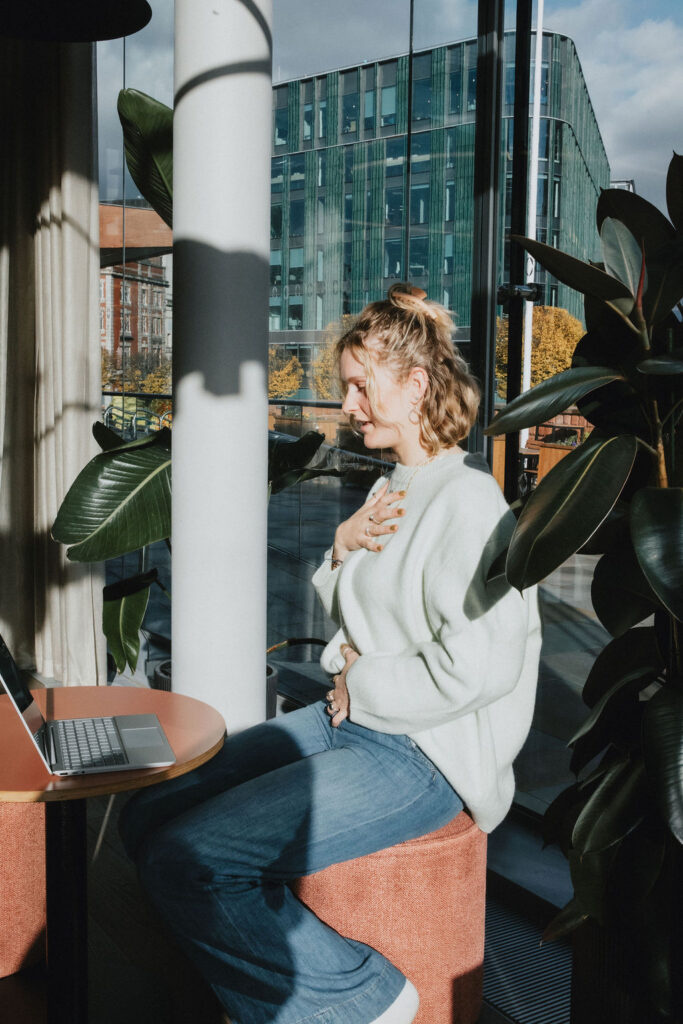
Place one hand on your chest and one on your belly.
Now breathe normally without changing anything.
Notice…
- Which hand moves more?
- Am I breathing through my nose or mouth?
- Is my breath fast or slow?
- Does my chest lift before my belly?
- Do my shoulders move as I breathe?
- Do I feel like I can’t get a deep breath?
- Do I sigh frequently?
- Do I feel tension around my shoulders, neck, or jaw?
If your chest is doing most of the work or your breath feels like hard work, you may be over breathing.
Awareness is always step one.
Shifting the breath is step two.
How to Shift Out of Over Breathing
As a general, here’s some simple ways to bring your system back into balance.
Note, this is general and there are assessments I do with clients to further assess their breathing, anxiety and stress levels to fully understand their patterns and make support specific to the individual. Take a look at UNBOUND here
1. Close your mouth and breathe through your nose
Nasal breathing calms the nervous system, warms the air coming in, produces nitric oxide (to name just a few benefits)
2. Slow your exhale
A long gentle exhale activates your parasympathetic system.
3. Let your belly soften
This allows the diaphragm to move the way it’s designed to.
4. Make your breath gentle.
Aim for light, quiet breathing..
If You Want to Explore This work in your own body…
This is exactly what I work on inside UNBOUND… helping you understand your breathing mechanics, your nervous system patterns and the somatic tools that shift stress at a physiological level.